
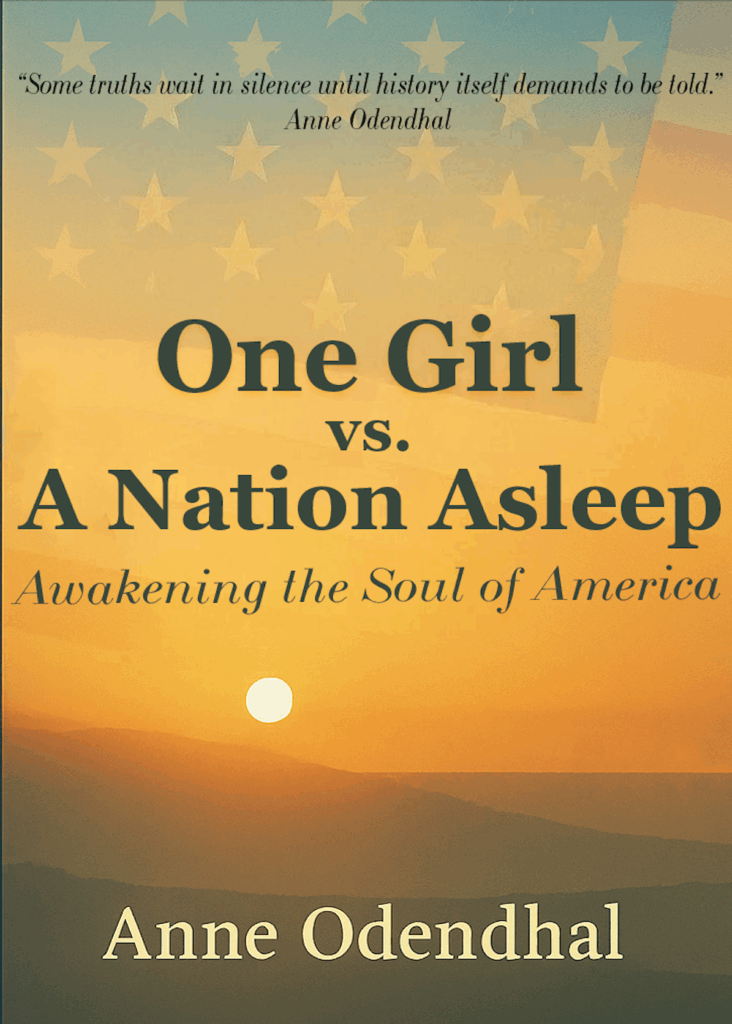
About the book
A family’s story. A nation’s turning point.
One Girl vs. A Nation Asleep traces the rise, fracture, and possible reawakening of modern America through the lived experiences of one Maryland family whose history mirrors the dilemmas of a nation.
Moving across decades of immigration, war, urban life, shifting moral foundations, and cultural upheaval, this narrative nonfiction work blends intimate family history with historical insight to illuminate the forces that shaped twentieth-century America. The personal and the national unfold together, revealing how private lives become witnesses to public transformation.
Written with the depth of cultural analysis and the vivid detail of narrative history, this is not an autobiography. It is a braided historical account — a story-driven exploration of American character, family inheritance, and the search for truth in a disoriented age. Through scenes of hardship, perseverance, civic life, and quiet courage, the book examines how ordinary people are formed by — and respond to — extraordinary national change.
One Girl vs. A Nation Asleep invites readers to see the past more clearly, to understand the present more honestly, and to consider what must be restored if a nation is to keep its soul.
What do I as the author wants readers to know?
I want readers to know that this book grew out of a lifelong engagement with history, family, and the question of how cultures are formed — and unformed — over time. I did not come to this work as a political commentator or academic theorist, but as a writer shaped by lived experience, historical study, and a deep concern for truth, memory, and moral clarity.
My background includes work as a journalist, technical writer, educator, and counselor, and I have spent many years listening to people’s stories — not only what happened to them, but how they understood what happened, what they remembered, and what they passed on. Over time, I became increasingly aware of how often modern discussions of history flatten human experience into slogans or abstractions, severing events from the families and moral frameworks in which they unfolded.
One Girl vs. A Nation Asleep was born from the conviction that history is best understood through lived experience. The book began as an effort to preserve and examine my own family’s story — not to memorialize it, but to ask larger questions about how ordinary lives intersect with national change. As I worked, it became clear that this family’s journey mirrored many of the cultural, moral, and civic shifts that shaped twentieth-century America more broadly.
The book took years to write because it required care — care with memory, with sources, with moral judgment, and with the people whose lives are represented. I was not interested in nostalgia or polemic. I wanted to tell the truth as honestly as possible, showing both strength and fracture, perseverance and loss, and allowing readers to draw their own conclusions.
Readers considering this book should know that it was written with intentional restraint. It does not tell them what to think, but it does ask them to slow down, to pay attention, and to consider how family structure, moral imagination, and generational inheritance quietly shape both personal destiny and national character. Especially for younger readers, the book is an invitation to see themselves not as detached observers of history, but as inheritors of it.
Ultimately, I hope readers sense that this book was written not for attention or argument, but out of responsibility — a belief that remembering honestly is one of the ways a culture repairs itself.
Key points that I the author feel are especially important for readers to grasp about my book
There are several key points I hope readers understand as they engage with the book:
• This is narrative nonfiction, not an autobiography or a polemic. While it draws from family history, the purpose is not self-expression but illumination — using lived experience to understand broader historical and cultural forces.
• The book approaches American history through ordinary lives, showing how national change is not driven only by leaders or events, but by countless quiet decisions made within families, communities, and institutions over time.
• History in this book is treated as lived memory, not dry facts. The past is not presented to romanticize or condemn, but to understand how values, moral frameworks, and cultural assumptions are formed, transmitted, and sometimes lost across generations.
• The book does not argue a political program. Instead, it invites readers to develop clarity — to see how cultural fragmentation unfolds, how moral foundations matter, and how private life and public life are inseparably linked.
• Especially for younger readers, the book aims to show that they are not disconnected from history. They are inheritors of stories, structures, and choices that shape the world they are stepping into — and understanding that inheritance is essential to shaping the future wisely.